Small Business AI Adoption Statistics: Read the Scope
By Nick Bryant, Co-Founder and CTO, SMB Investor Network
5 min read
In brief
Read small business AI adoption statistics with their survey scope intact. Separate reported use from payoff and frame a better technology decision for a team.
Small business AI adoption statistics tell you how many surveyed businesses say they use AI. They don't tell you whether buying AI will pay off in yours. An owner who treats an adoption headline as an investment case can end up paying for software while the operating problem stays exactly where it was.
Roughly one in five businesses say they use AI1. The overall rate doesn't say which functions each business uses it for. Start with the job, not the percentage.
What Census measured
The US Census Bureau's Business Trends and Outlook Survey, summarised in an America Counts story, reported that overall AI use by US businesses hovered between 17% and 20% from December 2025 through May 20261. That is overall business AI use over that period, and nothing narrower.
The population is US employer businesses, excluding farms, which is not the same group as the owners who read this publication. Census breaks out AI use by employee count2, but the overall figure is not tailored to your revenue, customers or paperwork. Don't relabel it as the adoption rate among businesses like yours.
The period is a range. The Census story reports growth since December 2025, but says the change was not significant among smaller firms. The overall range alone doesn't show what happened at a business your size.
The Census story says the survey asks about AI use in any business function during the past two weeks and points to a supplement covering specific functions. The overall adoption rate doesn't identify which functions each business uses AI for.
Keep that in mind when someone puts the number on a sales slide. It shows that AI use is being measured across businesses. It doesn't show which task deserves money, whether the information feeding that task is reliable, or whether your staff can act on the output. Pricing what a task actually costs, the model bill and the human minutes both, is a better starting point than an adoption percentage.
Say an owner wants help with slow customer replies. The decision is about why replies are slow and what would change the customer's experience. An overall adoption figure can't tell missing information from unclear responsibility from work software could help prepare.
What the owner survey measured
The Goldman Sachs 10,000 Small Businesses Voices survey reported that 76% of small business owner respondents used AI, while 14% said it was fully embedded in core operations3. The sample was 1,256 Goldman Sachs 10,000 Small Businesses program participants, surveyed from January 27 to February 4, 20263. These are findings from that sponsor's respondents.
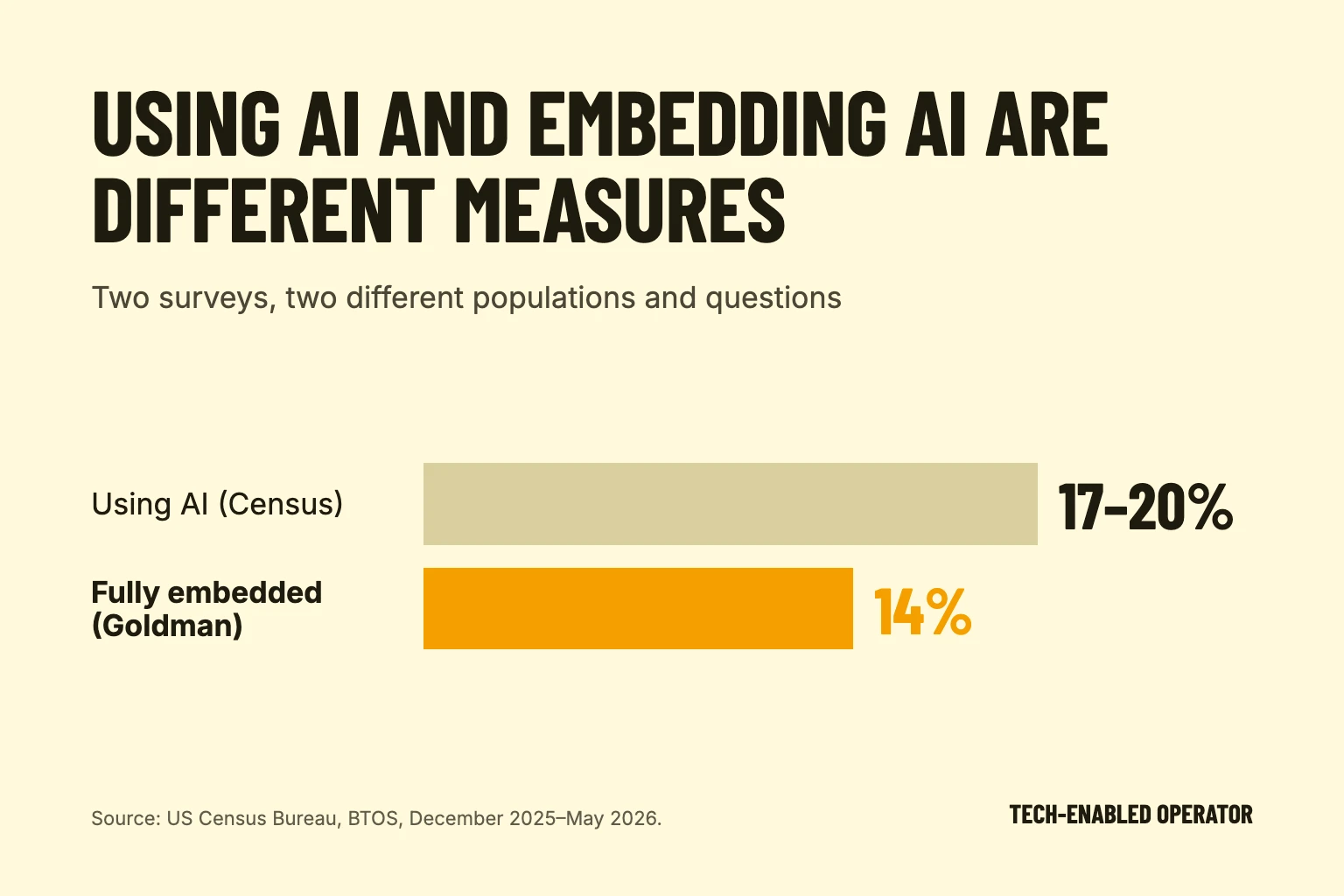
AI use and embedded AI are different measures
Two separate survey panels: Census reports 17–20% of US businesses using AI; Goldman reports 14% of surveyed small-business owners with AI fully embedded in core operations. Different populations and questions; these are not a comparable series.US businesses · Census BTOS
Using AI · December 2025–May 2026
Small-business owners · Goldman Voices respondents
AI fully embedded in core operations · January 27–February 4, 2026
Separate surveys, different questions and populations. The outlined segment marks the Census range.
Source: US Census Bureau, BTOS, December 2025–May 20261. Goldman Sachs 10,000 Small Businesses Voices survey, January 27–February 4, 2026 (1,256 respondents)3.
Figure data
| Population | Measure | Share | Period |
|---|---|---|---|
| US businesses · Census BTOS | Using AI | 17–20% | December 2025–May 2026 |
| Small-business owners · Goldman Voices respondents | AI fully embedded in core operations | 14% | January 27–February 4, 2026 |
In the Goldman survey, 76% of respondents reported using AI, while 14% said it was fully embedded in core operations3. Most respondents use AI somewhere; few say it is built into how the business runs. Neither figure tells you about the quality of the work, who still checks it, or what it did to the bottom line.
The press summary doesn't give the exact question or how respondents were told to read "fully embedded", and it doesn't give enough on how the sample was drawn to treat it as representative of all US small business owners. Keep the word "respondents" when you repeat the result. Dropping it turns a statement about people who answered a survey into a statement about every small business.
Embedded use is still an incomplete description for an owner. Software might draft a customer reply while a person stays responsible for whether it's accurate and appropriate. Knowing AI was involved doesn't tell you whether the customer got a useful answer. Our piece on AI customer follow-up looks at that responsibility in the actual work.
Why the two figures differ
Census covers overall use by US employer businesses, excluding farms; the Goldman survey covers its own small business owner respondents. The periods differ, and nothing in either summary shows the questions measured use the same way.
So you can't compare them directly. You can't compute a meaningful gap, infer a national trend by moving from one to the other, or say either one contradicts the other.
| Check the scope | Census | Goldman owner survey |
|---|---|---|
| Who does it describe? | US employer businesses, excluding farms. | Goldman Sachs 10,000 Small Businesses program participants who answered the survey3. |
| What does it measure? | AI use. | Reported use, and full embedding in core operations. |
| What does the timing tell you? | A range across the period. | The survey's field dates. |
| Does it say anything about payoff for your business? | No. | No. |
This matters because statistics travel. A source summary becomes a headline, then a sales slide, then an internal reason to buy. The number stays accurate while the population and definition fall off, and the argument built on it stops holding up.
A figure about reported AI use can't support a claim that most businesses like yours have automated their customer service. That would need evidence about comparable businesses, that specific activity and what "automated" meant.
"Fully embedded" isn't a maturity ranking either. An owner may have good reasons to keep experienced review in place or leave a working process alone. Neither survey shows that deeper integration gives better results.
What adoption can't tell an owner
Adoption figures can't tell you whether the work problem is understood, whether staff have reliable records, whether a customer needs an exception or whether anyone has authority to fix the issue. Those questions remain when software produces a plausible answer.
An interview guest argues that AI could reduce back-office coordination and make execution more predictable. That's a view about where the tools are going; the interview doesn't give an adoption rate, show the benefit or report a return. The useful part is the test: judge a tool by whether the work gets more consistent, not only by whether admin time falls.
Another interview guest described software that automates the preparation of quality-of-earnings work while an experienced adviser still handles interpretation. The same split applies to an owner's decisions: producing information is one job, deciding what it means is another. Adopting AI doesn't remove the second.
Take a summary of unfinished work. Software may pull the records together. A person may still need to notice that a record is incomplete, or that a customer commitment changes what it means. That is why automation still needs human judgment, and why data quality comes before trusting a useful-looking output. An adoption statistic says nothing about your records.
Questions for your team instead of a percentage:
- What work is causing trouble for customers or staff?
- What do the records show about that trouble?
- Where does someone still need to interpret context or decide?
- Who is responsible for the work and its outcome?
- Would a clearer owner or better information fix the problem?
- How much ongoing attention would a technology change need?
The answer may be simpler than adding AI: a better instruction, a clearer handoff, or using the software you already have more consistently. No adoption headline chooses among those for you.
If the only reason your team can give is keeping up, go back to what to automate first and name the problem before the tool.